
Offices
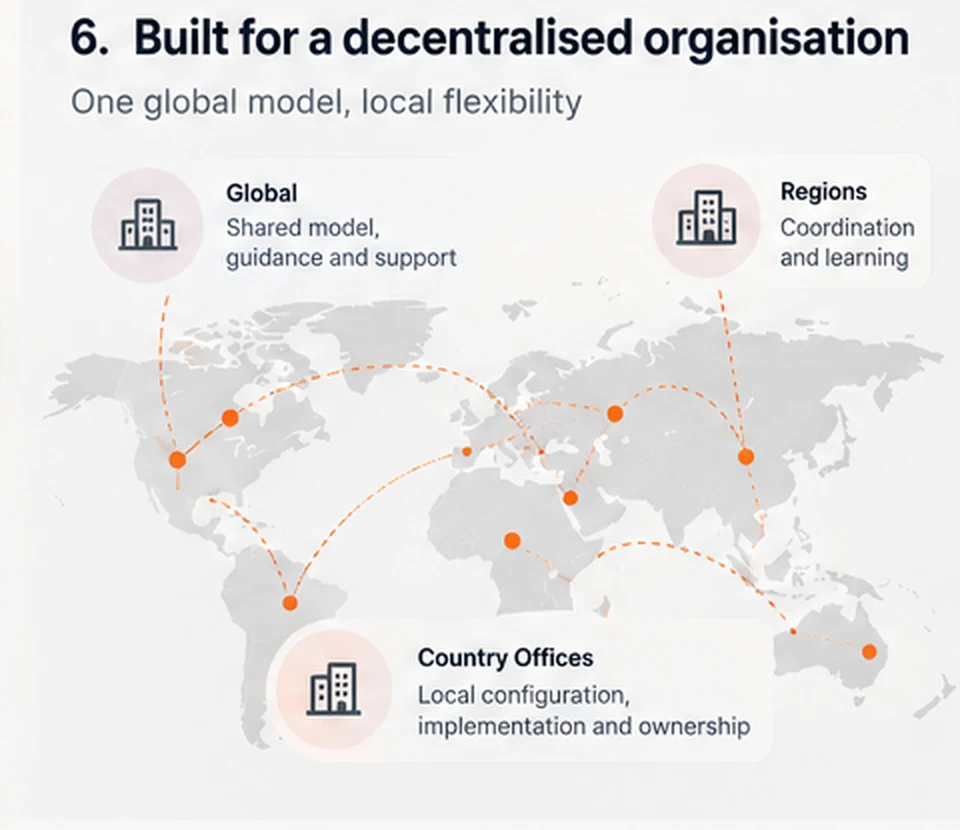
Organise the hierarchy between offices — for example Area Office → Country Office → Region — including the direction in which information can be consolidated.
CORE / Administration
Represent offices, teams, positions, locations, users and reference data so programme information is connected to the organisation that delivers it.
Need-to-know by design
Administrative configuration helps document responsibilities, but one of its main purposes is to organise access. CORE follows a need-to-know principle: the organisational setup supports secure, role-based visibility across programmes and participant information.
01 / Organisational structure
CORE provides reusable organisational structures that can be referenced throughout programme configuration and delivery.
Organise the hierarchy between offices — for example Area Office → Country Office → Region — including the direction in which information can be consolidated.
Represent teams, positions, managers, departments and sectors involved in programme delivery.
Maintain reusable locations, administrative levels, PCodes and GIS references.
Connect users to their organisational responsibilities.
Control what users can access according to their role and scope.
Maintain shared values used across programme operations.
A fundamental principle
Administrative configuration is not only about documenting the organisation. It provides the structure needed to control who can see what. CORE is designed around need-to-know access: users should access the data required for their role, responsibilities and organisational perimeter — not everything simply because it exists.
02 / Configuration that flows into operations
Offices, teams, positions, locations and reference data can be configured once and reused in Projects, Activities and Activity Implementations. The same structure supports both operational accountability and appropriate access to sensitive information.

A shared centralised system also supports cross-programming and collaboration with local NGOs. Agreed roles, responsibilities and access rights help partners coordinate delivery and hand over work while respecting need-to-know information sharing.
See CORE in action