
A stable foundation
Participants · Projects · Activities · Activity Implementations · Locations · Relationships · Identifiers
Product guardrails help preserve the model across programmes, staff changes and technical capacity.CORE / The approach
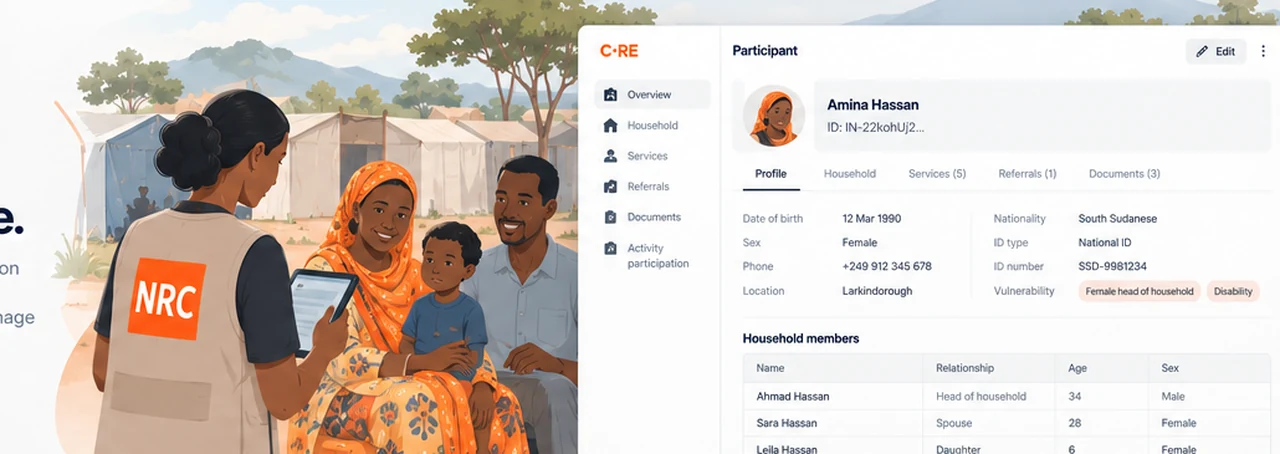
CORE starts from a simple idea: useful organisational data begins with tools that make sense to frontline programme teams. A stable, generic humanitarian data model structures that information at source — while leaving programmes room to adapt to their context.
A short version of the vision
When frontline teams get tools that help them do the job, they produce cleaner and more useful information. Standard formats, input controls and deduplication improve quality at source; less manual entry and rework save time and reduce administrative costs. Reporting and MEAL benefit from that operational foundation.
CORE therefore addresses the full chain: cleaner data in, more reliable outputs out.
The problem
Projects and decentralised offices need flexibility to deliver. But when each one defines its own datasets, structures and terminology, Country Offices later have to reconcile different files and models to build a coherent picture.
The challenge is different:
CORE provides a generic operational model that can support different organisations, sectors and humanitarian activities without rebuilding the fundamental relationships for every project.
The CORE answer
CORE connects reusable records and relationships in one centralised system. Authorised colleagues share the same information and can assign cases or Activity Implementations between team members and managers, preserving context across handovers.

Donor · Sector · Team · Coverage Area · Indicators · Targets
Participants · Location · Date(s) · Narratives · Forms · Items · Referrals · Attachments
One foundation. Local flexibility.
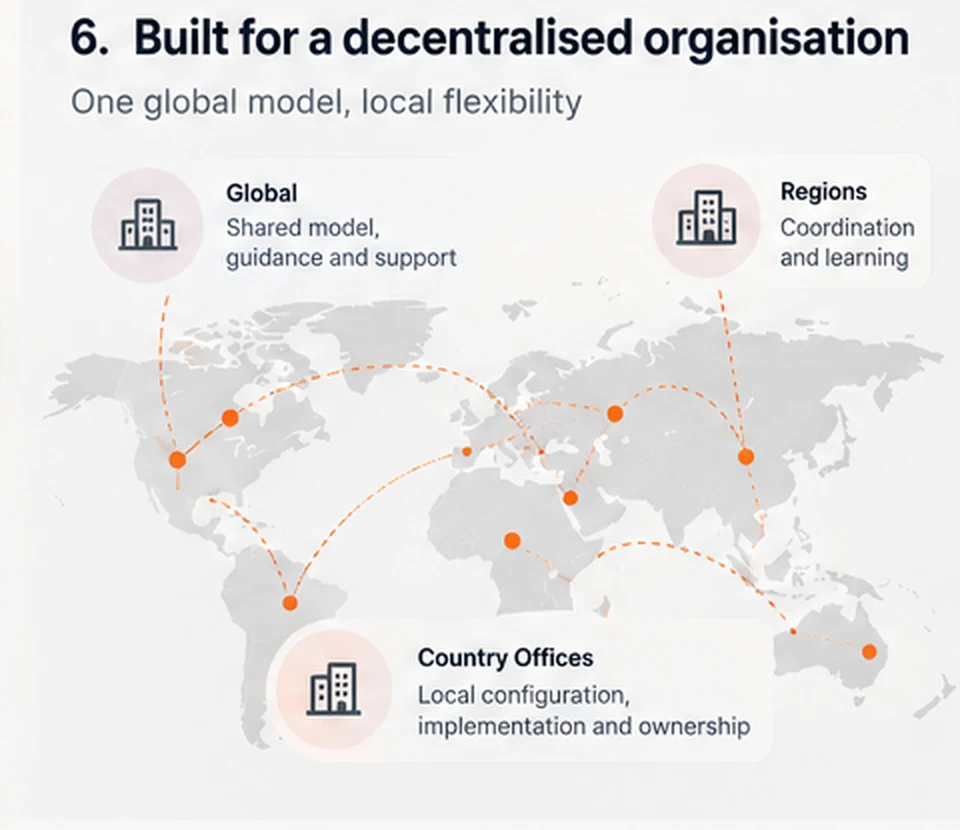
Standardisation only works if the standard survives. CORE puts the common architecture into the product itself, while providing governed ways to adapt programme-specific information.

Participants · Projects · Activities · Activity Implementations · Locations · Relationships · Identifiers
Product guardrails help preserve the model across programmes, staff changes and technical capacity.Country setup · Option lists · Additional fields · Ad-hoc information · Forms & Assessments
Programmes adapt their operational layer without redesigning the underlying architecture.The programme may change. The context may change. The forms may change. The underlying logic remains familiar.
Why this matters at organisational scale
A shared structure reduces repetitive work locally and makes information easier to understand and reuse as it moves through the organisation.
Register once, share authorised records and hand over assigned work with its context. Less repetitive entry leaves more time for delivery.
Connected participant and implementation histories support cross-programming, analysis and coordination across sectors and offices.
Area Office → Country Office → Region → Global becomes a data relationship, not a repeated reconciliation exercise.
Standard formats, validation and deduplication reduce cleaning. Reuse referenced operational data for automated reporting with fewer manual transfers and errors.
Localisation strengthens local organisations’ role in humanitarian action. Shared records, agreed responsibilities and access rights can support collaboration without parallel information silos.
Timestamped action logs and referenced Activity Implementations, participants and distributed items support audit work years later, subject to retention rules.
Participant, Project, Activity, Activity Implementation, Location and Team remain familiar across contexts.
The fundamental architecture belongs to the product, not to the person who built the last spreadsheet or dashboard.
Built for today. Ready for what comes next.
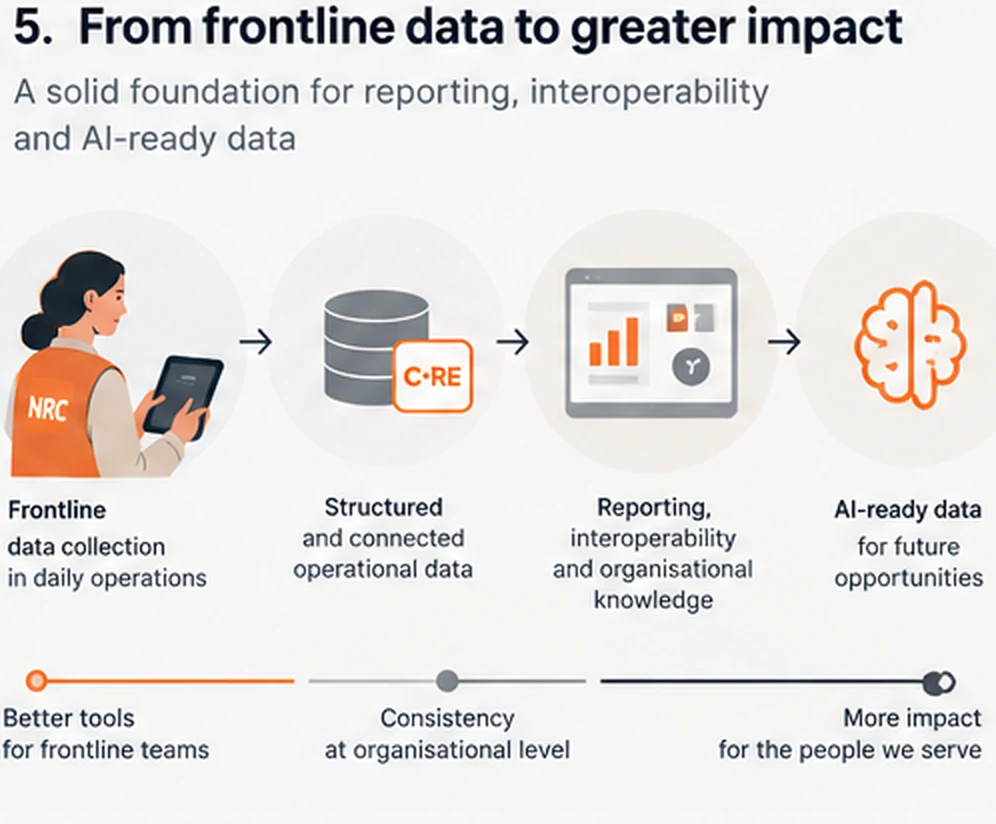
AI is only as useful as the data it can work with. CORE creates consistent entities, stable identifiers, explicit relationships and operational context across projects and locations — making information easier for people, systems and future AI applications to understand and reuse.
WHAT MAKES DATA AI-READY?
CORE is not presented as an AI product. Its value is more fundamental: creating the structured operational data backbone that meaningful automation and AI depend on.
Better programme delivery comes first. Shared information, accountable handovers and quality controls reduce manual work today; connected audit trails, automated reporting and reusable data extend that value over time.
Explore how CORE works