Unique CORE ID
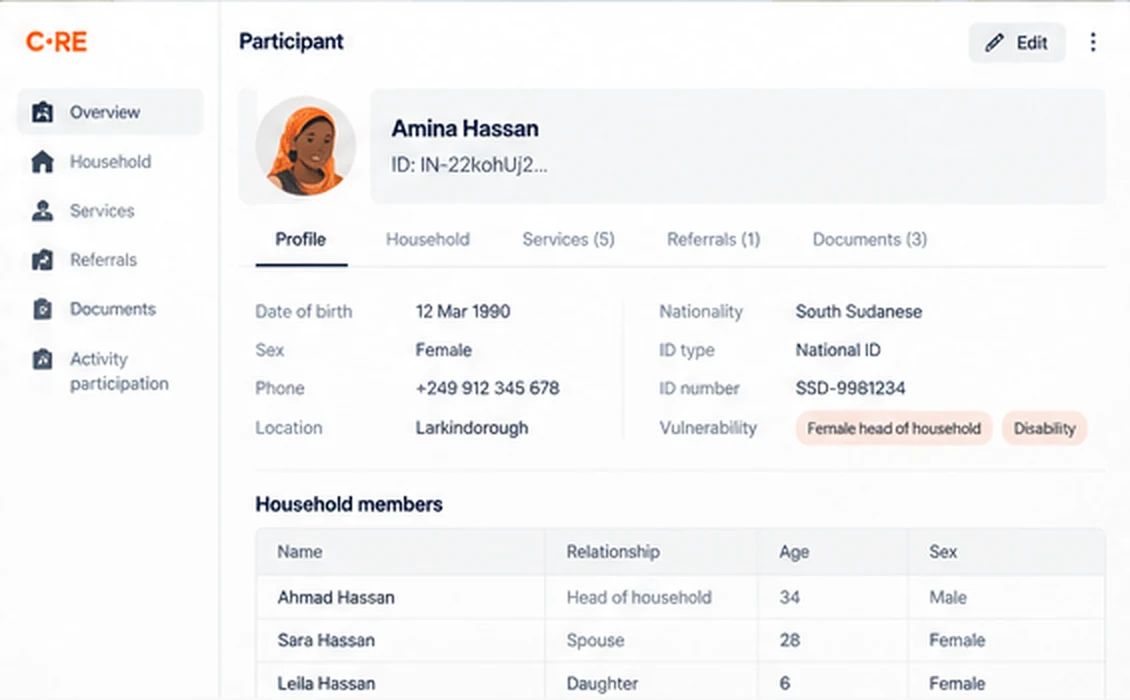
Give every record a stable identifier while retaining external IDs where needed.
CORE / Data Quality & Traceability
CORE improves data quality upstream — through structured daily programme operations — reducing the cleaning, reconciliation and reconstruction required downstream.

Reassurance for MEAL and reporting teams
CORE helps reduce the manual cleaning and reconciliation often required downstream. Unique identifiers, duplicate detection, controlled reference data and traceable operational history all contribute to more trustworthy datasets.
This is where the reporting benefits become tangible: data quality improves because the operational foundation is stronger.
01 / Quality at source
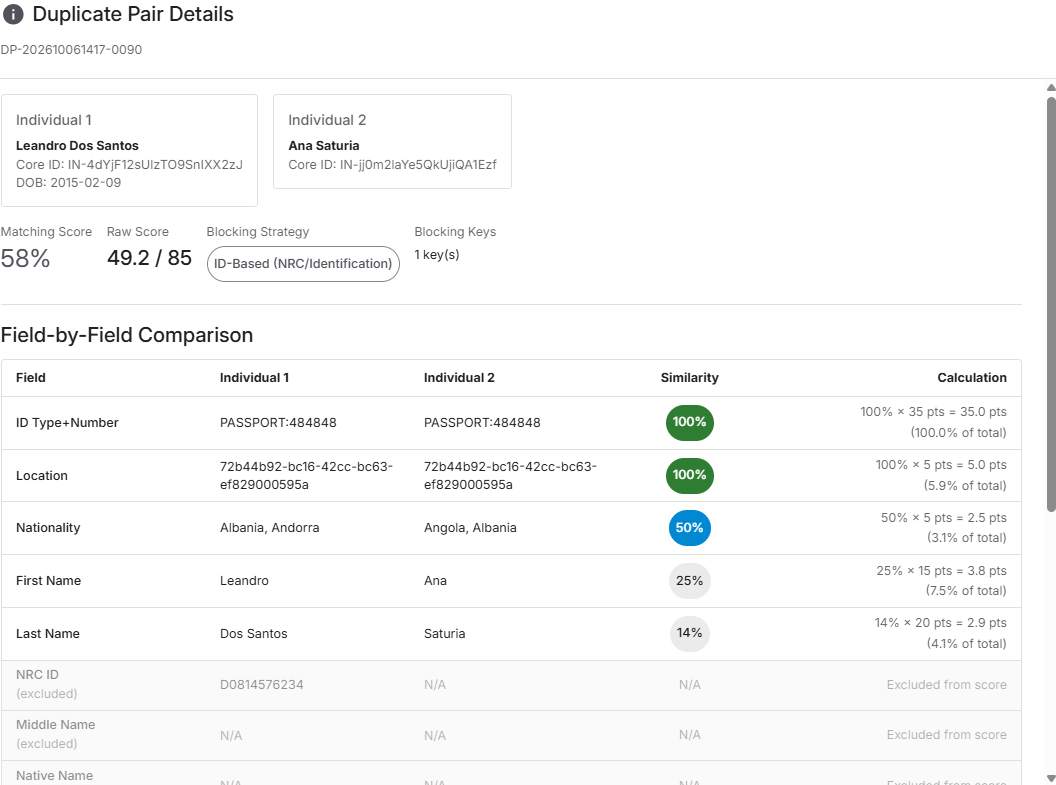
Standardised formats, entry controls, required fields, controlled reference data and deduplication improve data quality at source. Teams prevent inconsistencies during daily work instead of repeatedly correcting them at reporting time.
Give every record a stable identifier while retaining external IDs where needed.
Reduce multiple records for the same participant and strengthen unique participant counting.
Use required fields, controlled options and form logic to improve consistency.
Reuse locations, PCodes, sectors and other shared values instead of recreating them in every dataset.
02 / Context stays attached
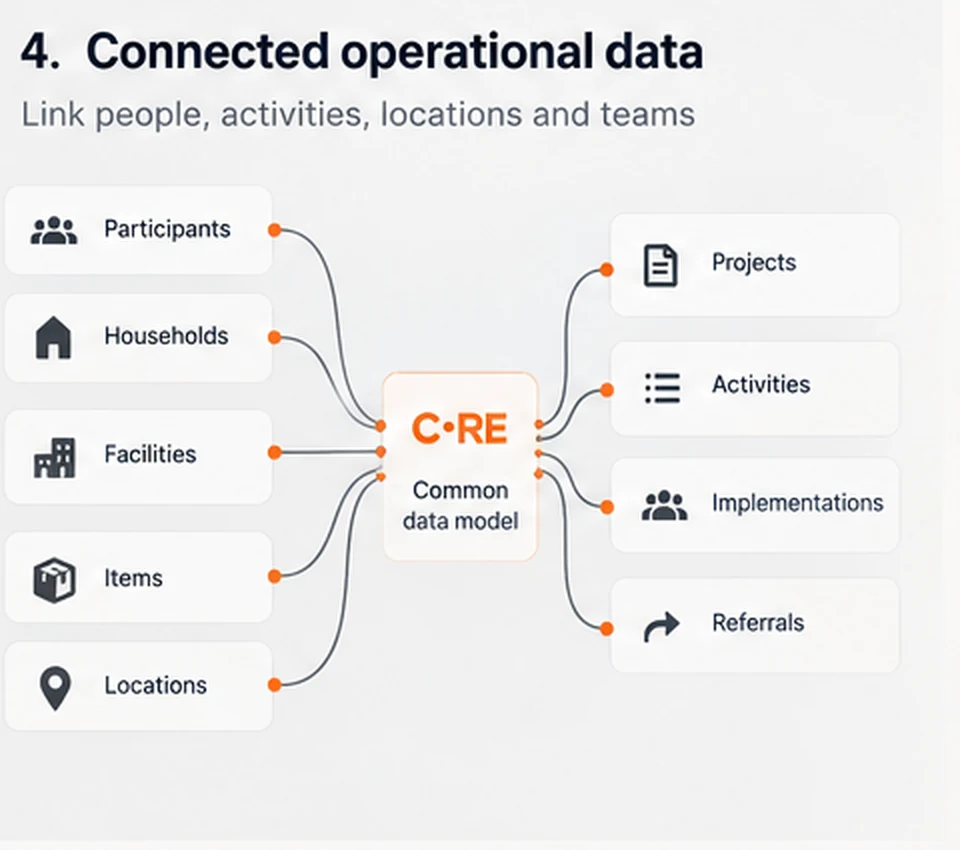
Authorised users can follow how information connects across participants, Activity Implementations, Forms & Assessments, referrals, locations, Projects and Activities. The relationships needed for analysis are created during delivery rather than reconstructed afterwards.
CORE logs all actions with timestamps. Referenced participants, Activity Implementations, distributed items and supporting records let authorised colleagues reconstruct what happened years later, subject to retention rules. This supports audit work as well as Finance and Supply reviews.
03 / Count what actually happened
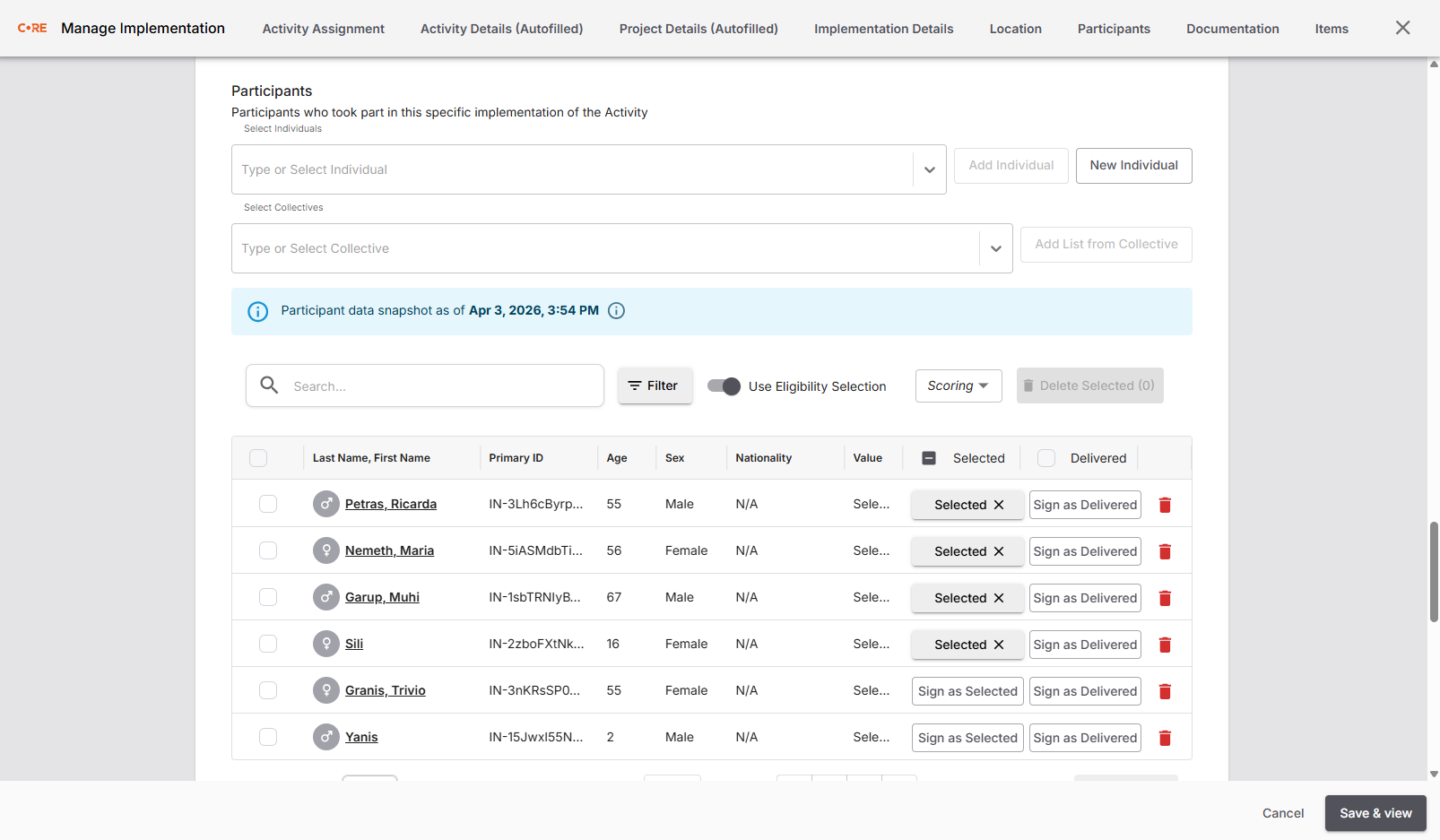
CORE can distinguish participants who were identified, selected and actually reached. Combined with unique participant identification and Activity Implementation history, this supports more meaningful counting and reduces double counting.
CORE includes a default counting algorithm based on commonly used population-counting and reporting rules. Teams can also configure custom counting rules to match specific institutional indicators or donor requirements, keeping calculations consistent with the intended measure.
AI readiness starts with data quality
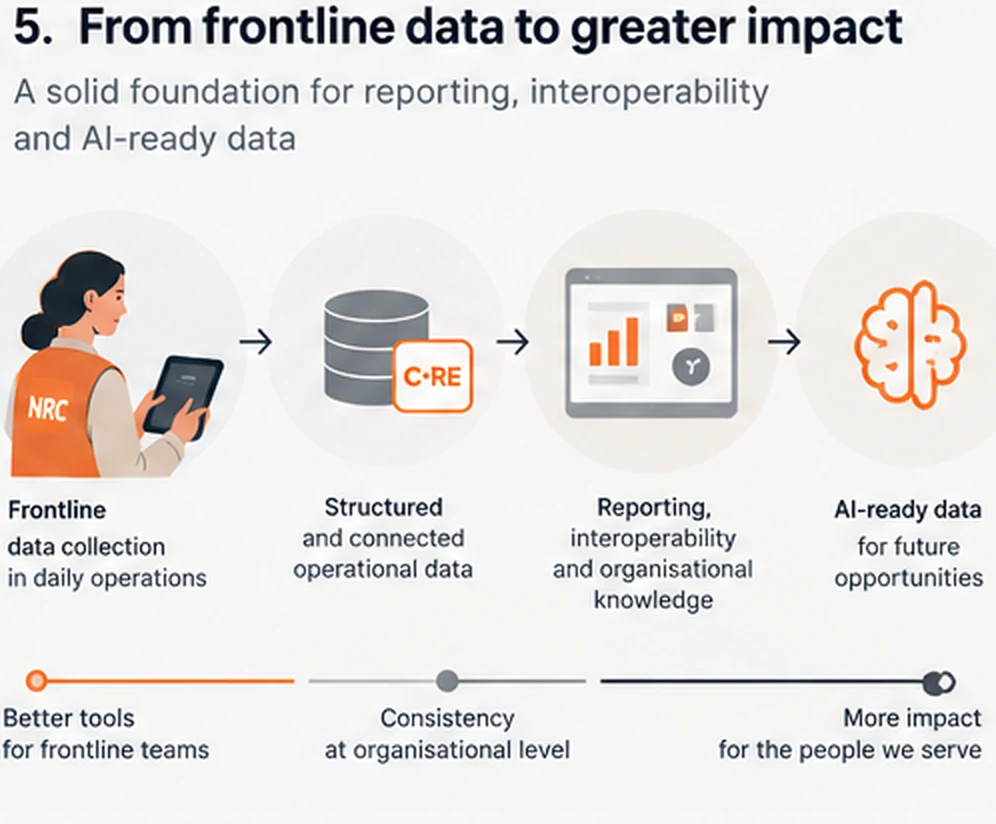
Stable identifiers, deduplicated records, consistent reference data and traceable relationships make operational information more reliable for people today — and more usable by automated and AI-enabled systems tomorrow.
For IM & MEAL
CORE is primarily used to support programme delivery, but reporting is designed into the model. Better structured data at source means less manual cleaning, mapping, deduplication and consolidation — and more opportunities to automate downstream work.
04 / The flow